On February 12, 2025, I had a dream. In it I saw a notation, and when I woke up, something clicked: it connected to a mathematical theory about quarks I’d been developing since 2016. I later found those notation values inside linear algebra and quantum field theory. Since March 2025, I’ve been building quantum circuits with the help of AI, and that work grew into an entire mathematical framework.
Along the way, working on Yang-Mills theory, I built glueball circuits on my own, the same kind of work university teams publish. No department, no grant, no team. Just me, a laptop, and AI tools that a few years ago only big institutions could have had.
Guerilla Science
That’s what I call it: independents like me, armed with AI and stubbornness, doing the kind of discovery people say only big labs can do. Big institutions and large AI companies like to tell the story that only they make discoveries. I don’t believe that. AI should make individuals more capable and more free, not more dependent on gatekeepers. That’s what this blog has always been about.
The Founders understood this. Article I, Section 8 of the Constitution gives Congress the power “to promote the Progress of Science and useful Arts, by securing for limited Times to Authors and Inventors the exclusive Right to their respective Writings and Discoveries.” Progress was meant to come from inventors, meaning individuals. AI puts that promise within reach of more people than ever.
Putting it to the test
Ideas are cheap, so I put mine up against other people. At the Duke Quantum Hackathon 2026, run by BlueQubit with DuQuantum, I placed 24th of 199.
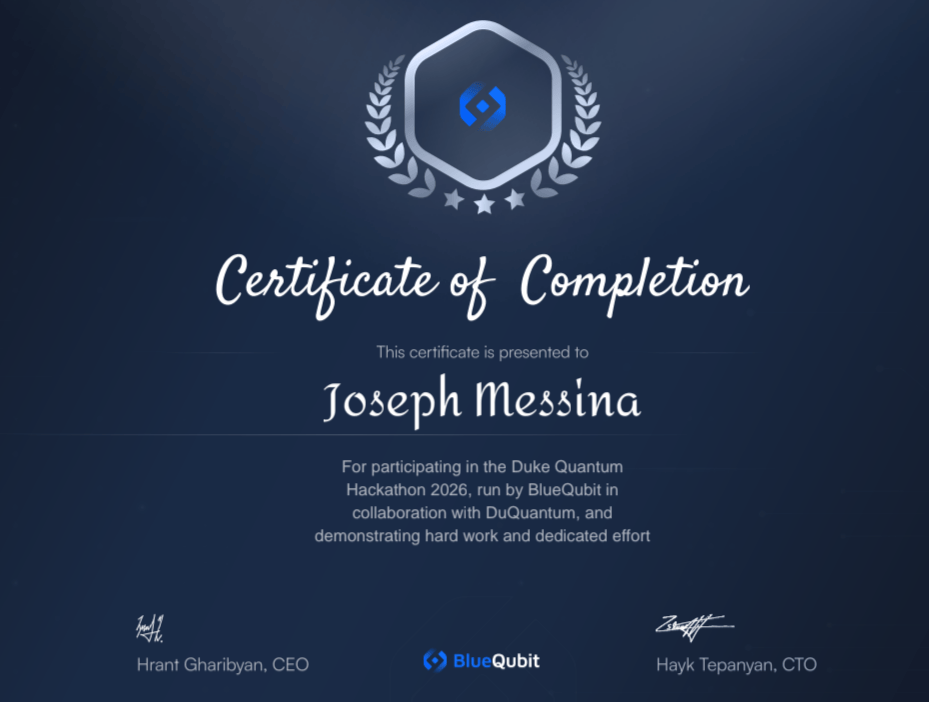
The biggest lesson wasn’t the ranking. Everything ran on classical simulators, and on the hardest circuits the real limit wasn’t computing power. It was truncation: the information an approximation quietly throws away to stay affordable. My best gains came from studying what was being thrown away and correcting for it honestly, with rules written down in advance wherever I could. On one problem that took me from 342 to 591 out of 600. You don’t need a giant budget to do careful science. You need discipline and the right tools.
The abundance bet
Now I’m applying the math to something practical. The question independent lab testing will help answer: can something we currently use once and throw away be made reusable? I don’t know yet, and I won’t pretend to. That’s what testing is for.
There’s a personal side too. I’m doing this to build a future on our family property with my dad.
I also see where this goes next. If AI lets people make their own things, it can also let independents fund science between each other: people backing the research they believe in directly, person to person, without waiting for permission from a gatekeeper. That’s my vision for the future of crowdfunding. It’s not a finished system, just an idea worth building toward.
The abundance bet is simple: abundance comes from individuals, not gatekeepers. AI is a tool that protects economic liberty: the freedom to invent, to build, and to pursue happiness on your own terms. If you want to follow along, my other posts here cover the project campaign, and my hackathon write-up on my quantum site walks through the technical side in detail.
— Joseph Messina, Banking to Bots


Leave a Reply